Media & Impact
From the wave flume to the Miami Beach coastline
Together with my advisor, Dr. Landolf Rhode-Barbarigos, and Dr. Brian K. Haus, I studied how submerged SEAHIVE® breakwaters transmit and dissipate wave energy, through laboratory wave-flume experiments at the University of Miami.
That work is now cited in the University of Miami's announcement of the SEAHIVE® hybrid reef deployed off Miami Beach, listed in the research library of the company that commercializes the system, and carried by science news outlets.
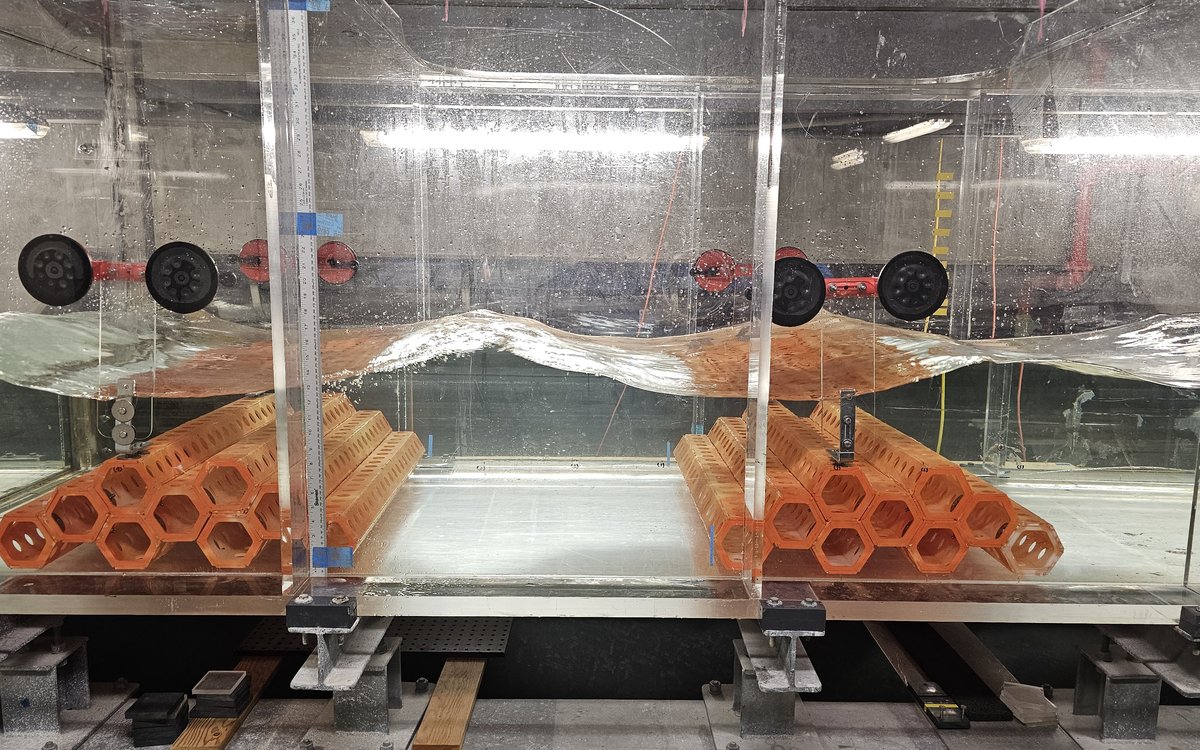
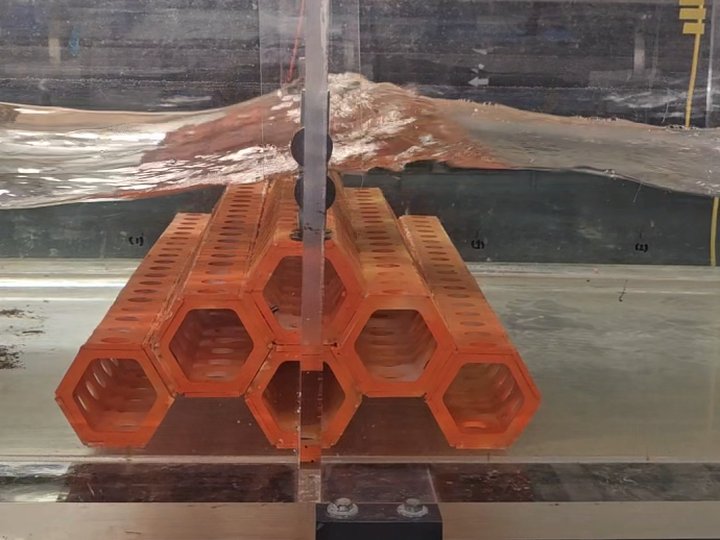
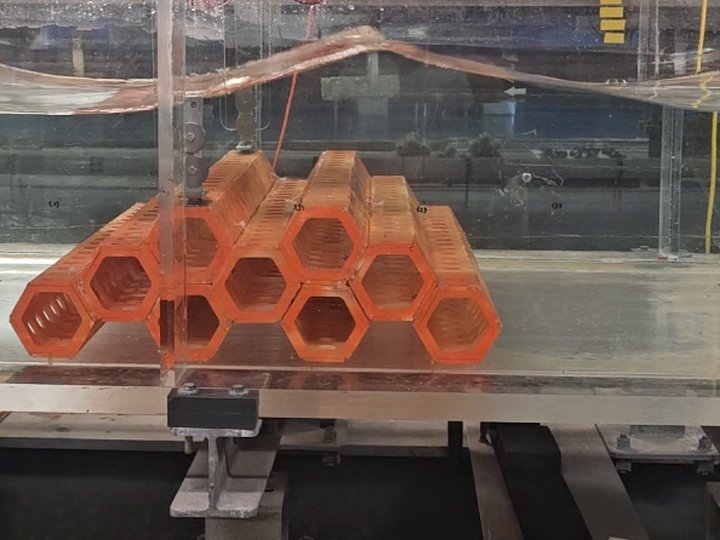
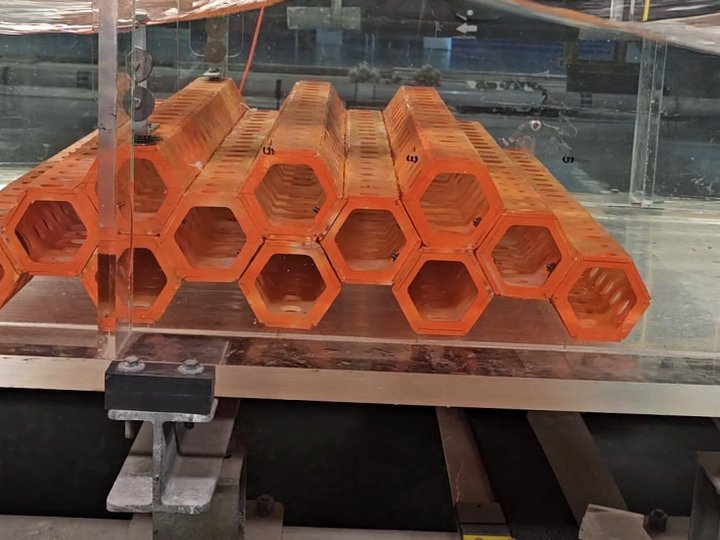
Configurations tested in Lamsal, Haus & Rhode-Barbarigos (2026). Photos by the authors, published under CC BY 4.0.
- 94th percentile for attention among research of the same age; top 25% of all outputs Altmetric
- 2 citing publications within five months of release (as of Sept 2026) Dimensions
- 4 news and blog outlets linked to the paper See coverage
- 3 SEAHIVE® clusters deployed off Miami Beach, June 2026 UM News
The research
Featured paper
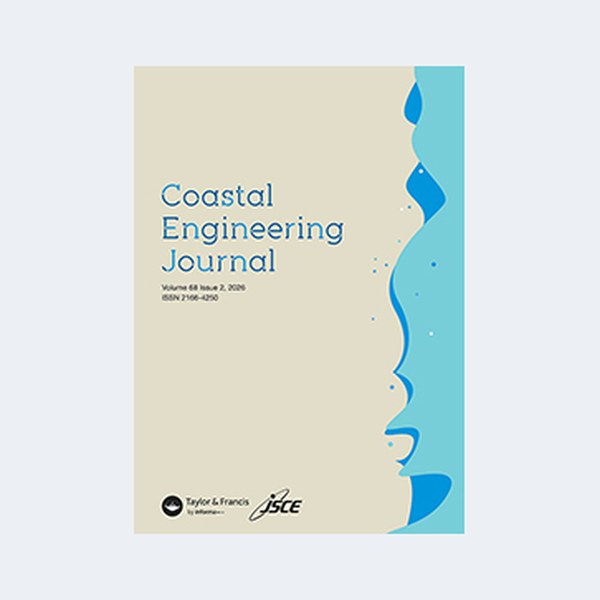
Peer-reviewed · Coastal Engineering Journal 68(3): 307–319 · Taylor & Francis · 2026
An experimental study on wave transmission over submerged SEAHIVE® breakwaters
“The SEAHIVE system’s porous, modular design improved wave attenuation compared with solid structures of similar size, with larger configurations further reducing wave transmission.”
Summary of our findings, University of Miami News, June 2026
The path
From flume to field
-
2023
First offshore deployment
The ECoREEF hybrid-reef project places its first SEAHIVE® structures offshore of Miami Beach.
Source: University of Miami News -
2024
Results presented
I present SEAHIVE® wave-dissipation results at ASCE Earth & Space 2024 and the 2024 Ocean Sciences Meeting.
Source: ASCE Earth & Space 2024 program (PDF) -
Dec 2024
Flume experiments
Perforated and solid SEAHIVE® configurations are tested in a scaled wave flume, including multi-unit and two-row layouts.
Source: Methods, Coastal Engineering Journal -
Aug 2025
Doctoral dissertation
Submerged Breakwaters for Coastal Protection: A Performance Review from Physical Testing, University of Miami.
Source: University of Miami Scholarship Repository -
Apr 2026
Published in Coastal Engineering Journal
Our wave-transmission study of submerged SEAHIVE® breakwaters appears in print.
Source: doi.org/10.1080/21664250.2026.2661171 -
Jun 2026
Phase 2 deployed off Miami Beach
Three 3D-printed SEAHIVE® clusters are installed about 750 feet off 81st Street, Miami Beach, during National Ocean Month. The University of Miami's announcement cites the findings of our paper.
Source: University of Miami News, June 24, 2026 -
Jun 2026
Science news coverage
Five outlets carry the story; Phys.org cites the paper by name. See coverage
Source: Phys.org, June 25, 2026 -
2026
Adopted as validation data
The paper enters the SEAHIVE® 3DCP™ research library. See commercial use
Source: SEAHIVE® 3DCP™ research library
Coverage
In the news
Research to practice
In commercial use
1Print · SEAHIVE® 3DCP™
Our paper in the system's technical library
SEAHIVE® was developed at the University of Miami. 1Print holds the exclusive worldwide license to produce it by 3D concrete printing, and manufactured the structures deployed off Miami Beach.
The SEAHIVE® 3DCP™ research library lists our paper, Lamsal et al. (2026), among the publications behind the system.
“Every aspect of the structure's physics was informed by engineering analysis and physical testing.”
“…from concept to real-world applications that support national security, strengthen coastal communities, and promote healthier oceans.”
“By deploying nature-based coastal infrastructure, we are strengthening our storm readiness, reducing the high costs of storm damage…”
National programs
Program support
Our study acknowledges support from DARPA's Defense Sciences Office through the REEFS program, and builds on SEAHIVE®, which was developed under the National Cooperative Highway Research Program (IDEA Project 213).
The wider hybrid-reef deployment off Miami Beach has been supported by DARPA's Reefense program, the U.S. Department of Defense, and a University of Miami U-LINK seed grant, as reported by University of Miami News. 1Print, which manufactures the 3D-printed units, holds a U.S. Army Small Business Innovation Research Phase II award (2024) for this work, with the University of Miami on its team.